

Organic pet food now accounts for 47% of premium purchases, driven largely by the belief that organic automatically equals healthier. That assumption feels logical, but the science tells a more complicated story. If you’ve been reaching for the organic bag out of habit or marketing pressure, this guide will walk you through what the label actually guarantees, what research genuinely supports, and how to make the best choice for your specific pet.
Table of Contents
- What does ‘organic’ mean for pet food?
- Health benefits and limitations: What science actually says
- Organic pet food for sensitive pets: Who actually benefits?
- What should guide your choice? Practical tips for picking pet food
- Our take: Why the organic debate overlooks what pets really need
- Explore high-quality pet food and healthy treat options
- Frequently asked questions
Key Takeaways
| Point | Details |
|---|---|
| Organic definition shifting | Recent regulatory changes mean ‘organic’ pet food labels are now less consistent. |
| No proven health edge | Scientific studies find most pets thrive on high-quality, regulated food—organic or not. |
| Sensitive pets are unique | Organic may help sensitive pets, but ingredient quality and AAFCO balance matter more. |
| Pet food decisions simplified | Focus on nutritional completeness, reputable sourcing, and your pet’s individual needs. |
What does ‘organic’ mean for pet food?
The word “organic” on a pet food bag carries real regulatory weight, but not as much as most people assume. In North America, the USDA’s National Organic Program (NOP) sets the rules, requiring that organic ingredients be grown without synthetic pesticides, artificial fertilizers, or genetically modified organisms. For meat ingredients, animals must be raised with access to the outdoors and without routine antibiotics or growth hormones.
Here’s where it gets complicated. The USDA proposed rescinding organic pet food standards in 2025, reverting pet food back to livestock feed rules rather than maintaining a dedicated pet food framework. That shift creates real inconsistencies in how products get certified across brands and states. Two bags labeled “organic” may have been held to very different standards depending on when and where they were certified.
Organic vs. conventional pet food: key certification differences
| Feature | Organic | Conventional |
|---|---|---|
| Synthetic pesticide use | Prohibited | Permitted within limits |
| GMO ingredients | Prohibited | Permitted |
| Antibiotic use in livestock | Prohibited | Permitted within limits |
| Artificial preservatives | Restricted | Permitted |
| AAFCO nutritional review | Not required | Not required |
| Third-party certification | Required | Not required |
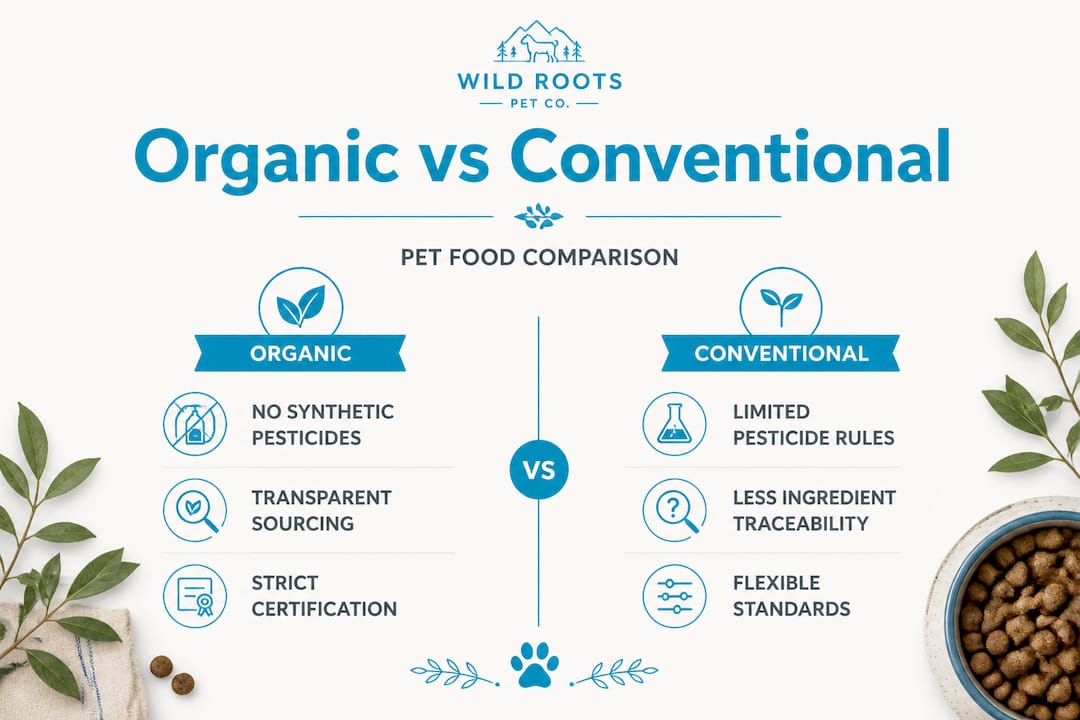
Notice that neither column requires AAFCO nutritional adequacy. That’s a critical gap that the organic label simply doesn’t fill.
Common misconceptions about organic pet food labels:
- “Organic” means the food is nutritionally complete. It does not.
- “Organic” means no preservatives at all. Some naturally derived preservatives are still allowed.
- “USDA Organic” on pet food means the same thing as on human food. The organic certification changes happening in 2025 and 2026 mean this comparison is increasingly unreliable.
- A product labeled “made with organic ingredients” is fully organic. That label only requires 70% organic content.
- Organic pet food is always free of recalls. Organic status has no bearing on contamination risk.
Understanding these distinctions isn’t about dismissing organic food. It’s about knowing exactly what you’re paying for and what questions to ask before you buy.
Health benefits and limitations: What science actually says
Once you know the organic label’s limitations, it’s essential to understand the genuine health benefits and the boundaries of what research shows. The honest answer is that the science is less dramatic than the marketing.
A thorough meta-analysis on additives found no adverse health effects from approved preservatives and additives in pet food when used within regulatory limits, with pooled risk differences near zero. That means the synthetic preservatives in well-regulated conventional food are not the hidden danger many pet owners fear. This doesn’t mean additives are ideal, but it does mean the risk is far smaller than the organic marketing narrative suggests.
Organic vs. conventional pet food: nutrition and safety comparison

| Factor | Organic | Conventional (AAFCO-compliant) |
|---|---|---|
| Nutritional completeness | Varies, not guaranteed | Guaranteed if AAFCO-labeled |
| Additive safety risk | Lower exposure | Low within regulatory limits |
| Protein quality | Depends on sourcing | Depends on sourcing |
| Price per serving | Significantly higher | Lower to moderate |
| Availability | Limited | Wide |
| Independent safety data | Limited | More extensive |
Common health claims vs. what research actually supports:
- Claim: Organic food prevents cancer in pets. Research finding: No peer-reviewed studies confirm this for pets.
- Claim: Organic food improves coat and skin. Research finding: Coat quality is more closely tied to omega fatty acid balance than organic status.
- Claim: Organic food boosts immune function. Research finding: Immune health correlates more with complete nutrition and gut microbiome diversity than ingredient origin.
- Claim: Organic food is easier to digest. Research finding: Digestibility depends on processing method and ingredient quality, not organic certification alone.
“The most important factor in selecting a pet food is whether it meets AAFCO nutritional standards for your pet’s life stage. A high-quality conventional food that carries an AAFCO statement often provides equivalent nutrition affordably compared to premium organic options that lack that guarantee.”
That perspective from veterinary nutritionists is consistent across most professional guidance. The AAFCO statement, not the organic badge, is your real nutritional safety net.
For pets with specific sensitivities, though, the picture shifts slightly. Reducing exposure to certain additives or switching to cleaner protein sources can make a meaningful difference. If your dog struggles with recurring skin issues or digestive upset, exploring low-allergen pet food options or a chicken meal supplement with transparent sourcing may be worth trying, even if the benefit comes from the ingredient simplicity rather than the organic label itself.
Pro Tip: For highly sensitive pets, focus on ingredient transparency and single-protein sourcing first. Organic certification is a bonus, not the primary goal.
Organic pet food for sensitive pets: Who actually benefits?
Understanding where organics might support specific needs helps you apply this knowledge practically, especially if you care for a sensitive pet. Not every dog or cat will respond the same way to a diet change, and the benefits of cleaner sourcing tend to be most noticeable in animals that already have underlying sensitivities.
Sensitive pets typically fall into a few categories. Some have true food allergies, where the immune system reacts to a specific protein like chicken or beef. Others have food intolerances, which cause digestive upset without a full immune response. A third group has environmental allergies that get worse when diet-related inflammation is high. For all three groups, simplifying the ingredient list and reducing additive exposure can help reduce the overall inflammatory load, even if organic status isn’t the direct cause of improvement.
Signs your pet may benefit from more careful ingredient sourcing:
- Recurring itchy skin, hot spots, or ear infections with no identified environmental cause
- Chronic loose stools or vomiting that isn’t explained by illness
- Excessive gas or bloating after meals
- Dull or thinning coat despite adequate protein intake
- Low energy or lethargy that isn’t explained by age or health conditions
- Picky eating that worsens after switching to foods with more additives or fillers
If your pet checks two or more of those boxes, it’s worth experimenting with simpler, more transparent food sources. A turkey-based topper for sensitivities or an antler powder supplement can be a low-risk way to introduce cleaner ingredients without overhauling your pet’s entire diet at once.
Organic pet food appeals through cleaner sourcing and is a reasonable choice for sensitive pets, but it lacks broad empirical proof of health superiority across all animals. The practical takeaway: organic sourcing can be one useful tool for managing sensitivities, but it works best as part of a complete, balanced diet rather than as a standalone solution.
Pro Tip: Always verify that any organic or specialty food carries an AAFCO or NRC nutritional adequacy statement before making it a daily staple. Cleaner ingredients mean nothing if the diet is nutritionally incomplete.
What should guide your choice? Practical tips for picking pet food
With insight into sensitive pets and organic choices, here’s how you can confidently navigate all pet food options without getting lost in marketing language.
The single most important thing you can do is read the packaging critically. Most pet owners scan the front of the bag, which is pure marketing. The real information is on the back and side panels.
What to always check on pet food packaging:
- AAFCO nutritional adequacy statement: Look for “complete and balanced for [life stage].” If it’s missing, the food is a supplement or treat, not a meal.
- Named protein source: “Chicken” or “salmon” is better than “poultry meal” or “meat by-products” when you want transparency.
- Ingredient order: Ingredients are listed by weight. The first three to five ingredients tell you the most about the food’s nutritional foundation.
- Guaranteed analysis: Check minimum crude protein and fat, and maximum fiber and moisture percentages.
- Manufacturer contact information: Reputable brands list a phone number or website for questions about sourcing and testing.
- Expiration date and lot number: These matter for traceability in case of recalls.
Brand reputation and manufacturing practices matter just as much as the label. Look for companies that conduct feeding trials rather than just formulation testing, and that publish their quality control processes. Organic certification from a brand with poor manufacturing standards is still a risk.
Processing impacts nutrient digestibility in ways that vary by method and ingredient, meaning a conventionally sourced food with superior processing can outperform an organic food that was poorly handled. Whole-food and organic claims need case-specific validation, not blanket trust.
A beef topper meal option with a single, traceable protein source can be a smarter addition to your pet’s diet than switching entirely to an expensive organic brand that doesn’t carry an AAFCO statement.
Pro Tip: Rotate protein sources every few months for most healthy pets. This reduces the risk of developing sensitivities to any one protein and supports a more diverse gut microbiome over time.
Our take: Why the organic debate overlooks what pets really need
Here’s the uncomfortable truth about the organic pet food conversation: most of it is driven by human psychology, not pet physiology. We project our own values around food onto our animals, and the pet food industry knows it. The organic label taps into genuine, well-intentioned concern for our pets’ health, but it often distracts from the fundamentals that actually move the needle.
We’ve seen pet owners spend two to three times more per month on organic food while unknowingly feeding a diet that lacks complete amino acid profiles or adequate mineral balance. The bag looked clean. The marketing was reassuring. But the AAFCO statement was absent, and the pet’s coat and energy reflected that gap over time.
The real question isn’t “Is this organic?” It’s “Is this balanced, digestible, and appropriate for my specific pet’s age, size, and health status?” Those are harder questions to answer, but they’re the right ones.
There’s also a tendency in the organic debate to treat all pets as identical. A young, healthy Labrador with no sensitivities and a robust digestive system will thrive on a wide range of well-formulated foods. A middle-aged rescue cat with a history of urinary issues and food sensitivities needs a completely different approach. Broad claims about organic being universally superior miss this case-by-case reality entirely.
What we believe matters most is ingredient transparency, honest sourcing, and nutritional completeness. A fish-based protein option with a single, traceable ingredient and an AAFCO-compliant base diet will do more for most pets than a full organic line built on marketing rather than nutritional science.
Diverse, reputable diets built around real evidence and your pet’s individual needs will always outperform any single label or trend. Organic can be part of that picture. It just shouldn’t be the whole frame.
Explore high-quality pet food and healthy treat options
Finding food and treats that are both thoughtfully sourced and nutritionally sound doesn’t have to be overwhelming.

At Wild Roots Pet, we’ve curated a line of single-ingredient toppers, treats, and chews designed for pet owners who want transparency without the guesswork. Whether you’re looking for a beef dog food topper to boost your dog’s daily meal, organic deer chews for a long-lasting natural chew, or convenient beef chips snack packs for training and travel, our products are built around real ingredients with clear sourcing. Every item is chosen to complement a balanced diet, not replace it. Browse our full collection and find the right fit for your pet’s unique needs.
Frequently asked questions
Does organic pet food reduce allergy risks for pets?
Organic pet food may help sensitive pets by reducing exposure to certain additives and fillers, but cleaner sourcing is most effective when paired with an AAFCO-balanced, limited-ingredient diet rather than relied on as a standalone allergy solution.
Is all organic pet food nutritionally complete?
Not necessarily. Only foods that carry an AAFCO nutritional adequacy statement are guaranteed to be complete and balanced, and AAFCO compliance is not a requirement for organic certification.
Are organic pet foods safer than conventional options?
Both types are generally safe when they comply with regulatory standards. A meta-analysis on additives found no adverse health effects from approved preservatives in pet food used within regulatory limits, meaning well-regulated conventional food carries minimal additive risk.
Did pet food organic standards change recently in the US?
Yes. The USDA proposed rescinding organic pet food standards in 2025, which would revert pet food certification to livestock feed rules and create inconsistencies in how organic claims are validated across different products.
Recommended
- Treat Topper Chicken Dog Food Topper | Healthy Meal Supplement for Dog – Wild Roots Pet Co.
- Treat Topper Fish Dog Food Topper | Low-Fat Meal Topper for Pets – Wild Roots Pet Co.
- Treat Topper Turkey Dog Food Topper | Healthy Meal Supplement for Dogs – Wild Roots Pet Co.
- Turkey Feast Chips – Wild Roots Pet Co.