

Bringing home a new puppy is exciting, but the nutrition aisle is genuinely overwhelming. You want clean, natural ingredients that align with your holistic values, yet you’ve heard that puppies have very specific nutritional requirements and that getting it wrong can cause lasting harm. The tension between “feed naturally” and “feed correctly” leaves many well-meaning owners guessing, switching foods repeatedly, or second-guessing every meal. This guide walks you through a clear, five-step workflow that merges evidence-based nutritional standards with holistic principles, so you can feed your puppy with confidence and purpose.
Table of Contents
- Understand your puppy’s unique nutritional needs
- Select the right food: AAFCO compliance and holistic choices
- Establish a feeding schedule and portions
- Monitor your puppy and troubleshoot nutrition issues
- Natural is great—when paired with proven nutritional standards
- Give your puppy a healthy, happy start with Wild Roots Pet Co.
- Frequently asked questions
Key Takeaways
| Point | Details |
|---|---|
| Know your puppy’s needs | Breed, size, and activity level drive all feeding decisions. |
| Prioritize balanced nutrition | Choose food that is AAFCO-compliant or professionally vetted for growth. |
| Use a structured workflow | Follow routine assessments and gradual changes to optimize outcomes. |
| Holistic is not hands-off | Natural diets require veterinary oversight for safety and balance. |
| Monitor and adapt | Regularly check your puppy’s weight, stool, and energy to make timely adjustments. |
Understand your puppy’s unique nutritional needs
Before you evaluate a single ingredient label, you need a clear picture of who you’re feeding. Not all puppies are the same, and their nutritional needs vary significantly based on breed, expected adult size, and activity level.
Large and giant breeds are the most striking example. A Great Dane puppy and a Chihuahua puppy may both be eight weeks old, but their calcium and phosphorus needs are completely different. Large breed puppies are prone to developmental orthopedic disease, a group of bone and joint conditions caused partly by uncontrolled calcium intake during rapid growth. Feeding a large breed pup a diet formulated for all life stages or small breeds can supply too much calcium, accelerating bone growth faster than the skeletal structure can safely handle. The result can be painful, long-term joint problems.
Expected adult weight also shapes how much food your puppy needs and how quickly they should grow. A dog expected to reach 10 pounds needs a different caloric density than one expected to reach 80 pounds. Activity level adds another layer, since a working breed puppy or a pup in a busy household with lots of play burns more calories than a lower-energy companion breed.
Before you select a food, make sure you know:
- Your puppy’s current weight
- Their expected adult weight (ask your breeder or vet if unsure)
- Their breed category (small, medium, large, or giant)
- Their daily activity level (low, moderate, or high)
- Any known breed-specific health risks (hip dysplasia, heart issues, allergies)
- Their current life stage (under 4 months, 4 to 6 months, 6 to 12 months)
Knowing these details upfront is the true starting point of puppy nutrition, and it makes every downstream decision easier and more accurate.
| Factor | Small/medium breeds (under 50 lbs adult) | Large/giant breeds (over 50 lbs adult) |
|---|---|---|
| Calcium target | Standard for growth | Controlled and moderate |
| Caloric density | Higher per lb of body weight | Moderate and steady |
| Growth rate goal | Faster maturation | Slow, controlled growth |
| Food label to look for | “Complete and balanced for growth” | “Large breed puppy” formula |
| Feeding frequency (8 to 12 weeks) | 3 to 4 times daily | 3 to 4 times daily |
| Feeding frequency (4 to 6 months) | 3 times daily | 3 times daily |

Pro Tip: If you’re unsure about your puppy’s expected adult weight, look up the breed standard or ask your vet at the first wellness visit. This single number shapes nearly every other nutritional decision you’ll make.
Select the right food: AAFCO compliance and holistic choices
With a clear understanding of your puppy’s needs, the next step is selecting the right food foundation, balancing safety, convenience, and holistic principles.
AAFCO stands for the Association of American Feed Control Officials. When a puppy food label says “complete and balanced for growth,” it means the food meets AAFCO’s minimum nutrient profiles for puppies. This isn’t marketing language. It’s a formulation standard that confirms the food provides adequate protein, fat, vitamins, and minerals for a puppy’s development. Choosing food without this statement means you cannot be certain the diet covers all your puppy’s nutritional bases.
Selecting AAFCO-compliant puppy food tailored to your pup’s breed size is the non-negotiable foundation. For small and medium breeds, a standard “complete and balanced for growth” label is sufficient. For large and giant breeds, look specifically for a “large breed puppy” formula that controls calcium and phosphorus ratios.
Now here’s where holistic owners often feel torn. Conventional vets emphasize AAFCO-compliant commercial foods, while holistic-minded practitioners often favor minimally processed, raw, or whole food diets. Both camps have valid points. The key insight is that these positions are not mutually exclusive.
“The goal isn’t to pick a side. It’s to ensure your puppy gets complete nutrition, no matter what form it arrives in.” A minimally processed diet that meets all growth-stage requirements is better than a conventional diet loaded with fillers. But a raw or homemade diet that’s nutritionally incomplete can cause real harm, no matter how clean the ingredients are.
Here’s how to think through your options:
- Commercial kibble or wet food: Easy to portion, shelf-stable, and typically AAFCO-verified. Look for named protein sources (chicken, salmon, turkey) listed first, and avoid artificial preservatives.
- Freeze-dried or dehydrated raw: Minimally processed and nutrient-dense, often AAFCO-compliant when rehydrated correctly. A strong middle-ground option for holistic owners.
- Raw or home-prepared diets: Highest level of ingredient control, but the highest risk of nutritional imbalance. Bacterial contamination is a real concern, especially for puppies whose immune systems are still developing.
- Hybrid feeding: Combining a verified commercial base with whole food toppers or single-ingredient treats can satisfy both standards and holistic values without compromise.
A great way to add excitement and palatability to your puppy’s bowl is to complement their base diet with a starter treat pack featuring single-ingredient training treats, which keep snack quality as clean as their meals. While you’re building healthy habits, a gentle chew toy made from natural plant-based ingredients also supports teething and enrichment without synthetic materials.
Pro Tip: If you want to feed a raw or minimally processed diet, work with a board-certified veterinary nutritionist to confirm the diet meets AAFCO growth-stage nutrient profiles before you start. Don’t rely on online recipes alone.
Establish a feeding schedule and portions
Once you’ve chosen the right food, it’s time to set your puppy up for success with a consistent, balanced feeding routine.
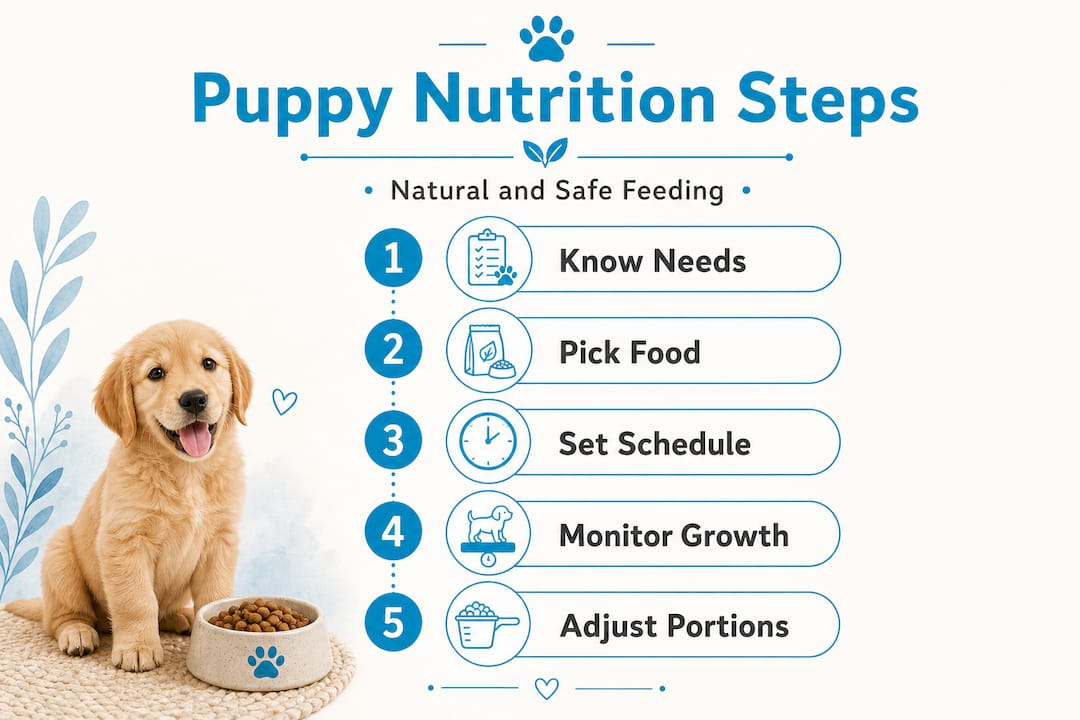
Meal timing matters more than most people realize. Puppies have small stomachs and fast metabolisms. Regular meals stabilize blood sugar, support healthy digestion, and actually help with house training because a predictable eating schedule creates predictable bathroom timing. Skipping meals or feeding erratically disrupts digestion and can cause loose stool or low energy.
Most owners rely on the cup measure printed on the food bag, but this is a rough estimate at best. The accurate approach is to use a kitchen scale. Weigh your puppy’s food in grams to match the manufacturer’s guidelines, which are usually based on current body weight and expected adult weight. A few grams too much every single day adds up over months and contributes to excess fat gain, which stresses developing joints.
Body Condition Score (BCS) is the other tool you need. BCS is a 1 to 9 scale used to assess whether a puppy is underweight, ideal, or overweight based on physical landmarks. At a healthy BCS of 4 to 5, you should be able to feel your puppy’s ribs easily but not see them, and there should be a visible waist when viewed from above. If you’re new to BCS, ask your vet to walk you through it at your next visit.
Here’s a practical setup for your feeding routine:
- Weigh your puppy every week on the same day, ideally in the morning before the first meal.
- Check the food manufacturer’s portion chart using your puppy’s current weight, not their expected adult weight.
- Weigh each meal portion on a kitchen scale and divide into daily meals based on age.
- Serve meals at the same times each day (morning, midday, and evening for young pups).
- Remove uneaten food after 20 minutes to prevent overeating and to maintain a schedule.
- Reassess BCS weekly and adjust portions up or down as your puppy grows.
“Weighing your puppy’s food removes the guesswork that leads to chronic overfeeding or underfeeding. It’s one of the highest-impact habits you can build in the first year.” Following this schedule and portioning approach gives your puppy the best chance at steady, healthy growth.
Pro Tip: As your puppy moves from 8 weeks to 6 months to 12 months, feeding frequency should decrease from 3 to 4 meals per day down to 2. Don’t rush this transition. Follow your pup’s energy and weight trends as your guide.
Monitor your puppy and troubleshoot nutrition issues
Your feeding schedule is in place. Here’s how to verify it’s working and what to do if things go off track.
Weekly monitoring is the verification layer of your workflow. Puppies change fast. A diet that worked perfectly at 10 weeks may need adjustment by 14 weeks. The three things to track consistently are weight, stool quality, and energy level.
Your weekly monitoring checklist:
- Record body weight every 7 days (same scale, same time of day)
- Note stool consistency (firm and formed is ideal; loose or mucousy stool is a warning sign)
- Observe energy levels during play (a well-nourished puppy should be bright and active)
- Check coat quality (dull, dry, or flaky coat may indicate a fat or nutrient deficiency)
- Look at muscle development (lean muscle over the back and hindquarters is a positive sign)
Healthy puppies in the right size category should gain weight steadily. Small breed puppies may double their birth weight within the first two weeks of life and reach adult weight by 10 to 12 months. Large breed puppies grow more slowly and may not reach full size until 18 to 24 months. Rapid or uneven growth in any breed is worth discussing with your vet.
Common nutrition problems and what to do:
- Loose or watery stool: Could signal too-rich food, a rapid transition, food sensitivity, or overfeeding. Cut portions by 10% and see if it resolves within 3 days.
- Low energy or lethargy: Could indicate insufficient calories, poor protein quality, or illness. Rule out illness first, then assess caloric intake.
- Excessive hunger after meals: May mean the food is low in protein or fiber. Check the protein percentage and consider a higher-quality formula.
- Coat dullness or dry skin: Often linked to insufficient omega-3 fatty acids. Adding a fish-based healthy treat options or a whole food topper can help.
- Bloating or gas: May result from eating too fast, switching foods too quickly, or a sensitivity to a specific ingredient.
When to contact your vet right away:
- Your puppy loses weight over two consecutive weigh-ins
- Stool contains blood or is black and tarry
- Your puppy refuses to eat for more than 24 hours
- Vomiting appears alongside other symptoms like lethargy or distended belly
- You notice significant limping or swelling around joints during growth phases
Schedule routine wellness visits at 3 months, 6 months, and 12 months. These appointments give your vet a chance to assess growth trajectory and flag nutritional concerns before they become serious problems.
Natural is great—when paired with proven nutritional standards
Here’s a perspective worth sitting with: the loudest voices in the puppy nutrition debate tend to be at the extremes. On one side, you have the “only AAFCO-certified kibble” camp. On the other, the “all commercial food is toxic” crowd. Both are wrong in their absolutism.
We believe strongly in natural, minimally processed nutrition. But we also know that ideology without science doesn’t serve puppies. A beautifully sourced raw diet that lacks adequate iodine causes thyroid dysfunction. A home-cooked meal missing calcium leads to bone fractures. These aren’t rare horror stories. They’re documented outcomes of good intentions without good data.
Holistic diets genuinely require expert balance checks to avoid bacterial contamination and nutritional gaps. This isn’t a knock on natural feeding. It’s an honest acknowledgment that natural ingredients alone don’t guarantee complete nutrition during one of the most demanding developmental windows in a dog’s life.
The most successful approach we’ve seen pairs clean ingredients with verified nutritional completeness. You can feed a high-quality, minimally processed base food, add all-natural treats made from single ingredients, and top meals with real whole food additions. All while confirming the core diet meets growth-stage standards. That’s not compromise. That’s smart nutrition.
The workflow in this guide is not anti-holistic. It’s the structure that makes holistic feeding work safely. Nature and evidence aren’t opponents. They’re partners when you have the right framework.
Give your puppy a healthy, happy start with Wild Roots Pet Co.
Ready to apply this workflow? The next step is finding high-quality products to round out your puppy’s natural nutrition.

At Wild Roots Pet Co., every product is chosen with your puppy’s growth and your holistic values in mind. Our puppy starter packs feature single-ingredient training treats that keep snack time as clean as mealtime. When you’re ready to elevate your pup’s bowl, our chicken food topper adds real protein and palatability without fillers. For something rich and savory, the beef food topper is a powdered whole food addition that pairs beautifully with any AAFCO-verified puppy base. Browse our full collection to find products built for puppies who deserve real food from day one.
Frequently asked questions
What does AAFCO-compliant puppy food mean?
AAFCO-compliant food meets the established minimum nutritional standards for puppies set by the Association of American Feed Control Officials, confirming it provides complete protein, fat, and micronutrient levels for healthy growth.
How often should I change my puppy’s portion size?
You should recalculate your puppy’s portions every week based on their current weight and BCS, since puppies grow rapidly and their caloric needs shift frequently in the first year.
Are raw or minimally processed diets safe for puppies?
Raw diets require careful balancing and veterinary oversight because they carry real pathogen risks and can easily miss key nutrients that puppies need during growth phases.
What should I watch for to know if my puppy’s diet isn’t working?
Warning signs include poor weight gain, persistent loose stool, dull coat, or low energy. Consult your vet if any of these persist beyond a few days or appear alongside other symptoms.
Recommended
- How to safely transition your dog to a raw diet – Wild Roots Pet Co.
- Natural ingredients for pet diets: healthier choices – Wild Roots Pet Co.
- Puppy Packs 'n Snacks Dog Treat Starter Pack | Single-Ingredient Train – Wild Roots Pet Co.
- BetterBone SOFT Durability CHEW TOY: Natural Plant-Based Ingredients, – Wild Roots Pet Co.