

Walking the pet food aisle — or scrolling through an online store — can feel like navigating a maze built by marketers. Words like “premium,” “natural,” and “ancestral” stare at you from every bag, but none of them are legally required to mean anything at all. If you’ve ever stood paralyzed trying to figure out what’s actually good for your dog or cat, this premium pet nutrition guide will give you the tools to cut through the noise. You’ll learn how to verify genuine nutritional quality, read labels with confidence, and match food to your pet’s real biological needs.
Table of Contents
- Understanding nutritional adequacy: the foundation of premium pet food
- How to read and interpret premium pet food labels
- Preparing to transition your pet to premium, natural nutrition
- Evaluating premium pet food options: beyond marketing claims
- The overlooked truths about premium pet nutrition
- Explore our premium pet nutrition products designed for wellness
- Frequently asked questions
Key Takeaways
| Point | Details |
|---|---|
| Verify nutritional adequacy | Look for AAFCO statements backed by feeding trials or validated formulation on pet food labels to ensure complete nutrition. |
| Match life stage | Choose diets specifically designed for your pet’s life stage to meet their unique nutritional needs accurately. |
| Read labels critically | Understand Purpose and Nutritional Adequacy Statements on packaging to distinguish marketing from verified quality. |
| Transition gradually | Switch to premium diets slowly over a week, monitoring your pet for digestive changes or intolerance. |
| Assess ingredients and claims | Evaluate ingredient transparency and distinguish substantiated functional benefits from marketing buzzwords. |
Understanding nutritional adequacy: the foundation of premium pet food
Before ingredient lists, before protein percentages, before anything else, there is one question worth asking about any pet food: does it actually prove it works? That’s what nutritional adequacy is about. It’s the foundation of every honest high-quality pet food guide, and most pet owners skip right past it.
AAFCO, the Association of American Feed Control Officials, sets the nutritional standards that define whether a pet food is “complete and balanced.” Every legitimate product on the market should reference AAFCO somewhere on its label. But here’s what most pet owners don’t know: not all AAFCO claims are created equal.
There are three ways a manufacturer can substantiate nutritional adequacy. First, formulation means the recipe was designed to meet AAFCO’s nutrient profiles on paper. Second, feeding trials mean the food was actually fed to live animals under controlled conditions, and those animals remained healthy. Third, the family method allows a new product to piggyback on the testing of a similar product in the same line. AAFCO feeding trials are considered a more rigorous way to substantiate nutritional adequacy than nutrient-profile formulation alone.
Why does that matter? Because a food can look perfect on paper but deliver nutrients your pet’s body can’t actually absorb. Bioavailability, meaning how well the body uses what it ingests, doesn’t show up in a formula.
Key facts to remember:
- “Premium” and “natural” are marketing terms with no regulatory definition in pet food
- Only feeding trials confirm nutrients are actually absorbed and used by the body
- The AAFCO adequacy statement on a label must specify a life stage (puppy, adult, senior, all life stages)
- Look for the phrase “animal feeding tests” to spot feeding trial evidence on the label
| Substantiation method | Proof level | Bioavailability confirmed | Best suited for |
|---|---|---|---|
| Nutrient profile formulation | Moderate | No | Budget-friendly or new products |
| Family method | Low to moderate | Partial | Product line extensions |
| AAFCO feeding trials | High | Yes | Primary diet selection |
Pro Tip: Scan the back panel of any bag for the phrase “animal feeding tests using AAFCO procedures.” If it just says “formulated to meet,” you’re looking at a paper-based claim, not a real-world test.
Understanding these distinctions also applies when evaluating functional pet treats and supplements that claim health benefits beyond basic nutrition.
How to read and interpret premium pet food labels
Nutritional adequacy is the foundation. Labels are the map. Once you know what to look for, reading a pet food label takes about 60 seconds and tells you nearly everything you need to know.

AAFCO regulations require clear nutritional adequacy statements on the front and nutrition facts sections of pet food packages to guide consumers. These aren’t optional. If a package is missing them, walk away.
Here are the label components you should check in order:
- Purpose statement. This tells you which species and life stage the food is for. “Adult dogs” and “all life stages” are not the same thing. A food labeled “all life stages” must meet the nutritional demands of growing puppies, which means it may contain more calcium and phosphorus than an adult dog needs long term.
- Nutritional adequacy statement. Look for “complete and balanced” along with the substantiation method and life stage. This is the single most important sentence on the label.
- Ingredient list. Ingredients are listed by weight before processing. A whole chicken may rank first, but chicken meal (a dried, concentrated form) lower on the list may actually contribute more protein per gram. Don’t be fooled by the order alone.
- Guaranteed analysis. This shows minimum or maximum percentages of protein, fat, fiber, and moisture. Compare on a dry matter basis to fairly evaluate wet and dry foods side by side.
- Manufacturer contact information. A phone number or website you can actually reach signals a brand willing to stand behind its product.
Watch out for these label red flags:
- No AAFCO adequacy statement anywhere on the package
- Life stage mismatch (e.g., senior dog food for a growing puppy)
- Vague protein sources like “meat meal” or “poultry by-product” with no species listed
- Long lists of synthetic vitamins and minerals compensating for nutrient-poor base ingredients
Pro Tip: When evaluating choosing reputable dog food, use the “3-second label test.” Find the AAFCO statement, confirm the life stage, and check the first three ingredients. Those three steps filter out most poor-quality options immediately.
You’ll also want to explore guidance on natural ingredients for pet diets to better understand which ingredient forms actually retain their nutritional value through processing.
Preparing to transition your pet to premium, natural nutrition
You’ve identified a food that meets the criteria. Now the question is how to actually get your pet eating it without causing a week of digestive chaos. This step gets skipped more than any other, and it’s why so many owners wrongly blame a good food for problems that were really caused by switching too fast.
Veterinary nutrition guidance stresses that diets should match your pet’s life stage and health for best results, and that gradual transition is critical to avoiding gastrointestinal issues. This isn’t just caution for caution’s sake. A sudden change can disrupt the gut microbiome (the community of bacteria that helps your pet digest food), causing loose stools, vomiting, or reduced appetite.
Before you buy anything, assess these factors:
- Your pet’s current life stage: growth phase (puppy or kitten), adult, senior, or reproductive (pregnant or nursing)
- Any known allergies, sensitivities, or diagnosed health conditions
- Current body condition score: too lean, ideal, or overweight
- Whether your vet has flagged any dietary restrictions in recent checkups
The 7-day transition schedule:
- Days 1 to 2: 75% current food, 25% new food
- Days 3 to 4: 50% current, 50% new
- Days 5 to 6: 25% current, 75% new
- Day 7 onward: 100% new food
If your pet shows soft stools or reduced appetite at any stage, slow down. Stay at that ratio for an extra two to three days before moving forward. Some pets, especially cats and seniors, need a 10 to 14-day transition.
Pro Tip: Adding a small amount of digestive support, like a probiotic formulated for pets, during the transition period can significantly reduce gastrointestinal upset. Pair that with a functional pet treat that supports gut health and you give your pet’s system a genuine assist during the switch.
Evaluating premium pet food options: beyond marketing claims
Now you can read a label, plan a transition, and understand what AAFCO adequacy actually means. The next step is evaluating specific products head to head. Here’s a practical framework that cuts through marketing and gets to what matters.
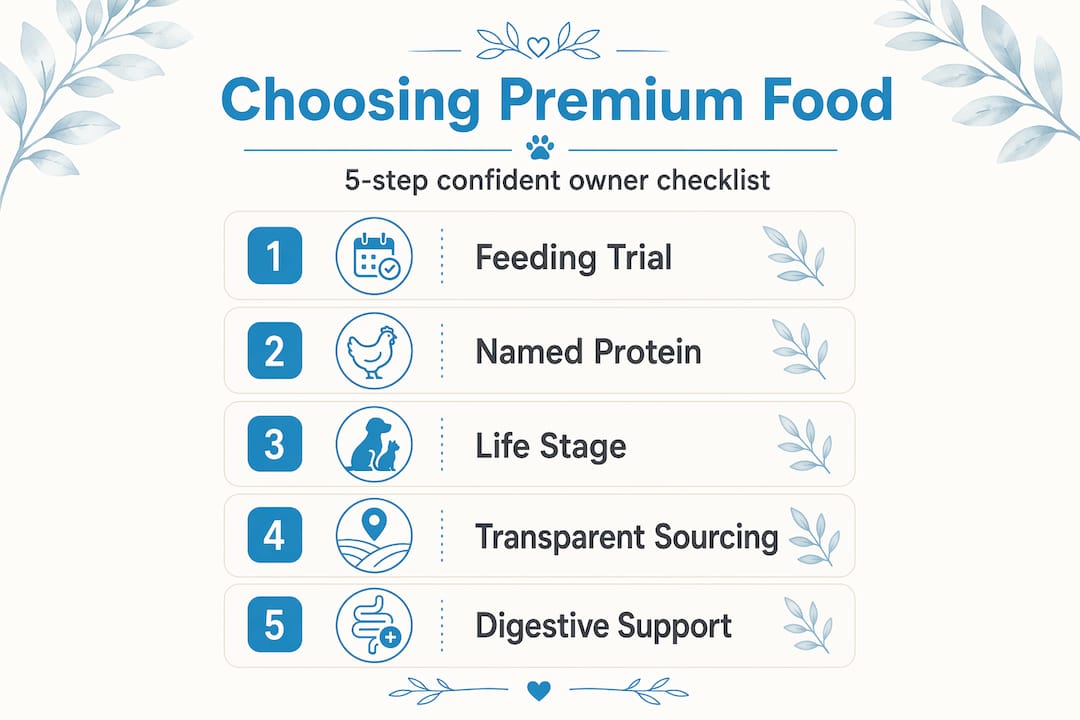
Start with the non-negotiables:
- AAFCO complete and balanced claim, ideally substantiated by feeding trials
- Life stage match to your specific pet right now, not a generic “all life stages” default
- Named protein sources (salmon, lamb, beef) rather than vague descriptors
- Short synthetic vitamin supplement list, which signals a nutrient-rich base rather than a patched-up formula
Then go one level deeper:
- Research the manufacturer. Do they have a full-time veterinary nutritionist on staff? Do they publish their feeding trial data?
- Understand the processing method. Cold-pressed, freeze-dried, and raw formats retain more of the natural ingredients nutritional value than high-heat extrusion, which is the standard kibble-making process.
- Evaluate functional ingredients with skepticism. Probiotics, omega-3 fatty acids, and prebiotics have genuine, research-backed benefits for pets. Vague terms like “botanical extracts” or “wellness blend” are often unsubstantiated marketing. Look for specific strains, concentrations, or sourcing details to verify functional benefits are real.
| Quality indicator | What to look for | Red flag |
|---|---|---|
| Protein source | Named species (salmon, turkey) | “Meat” or “poultry” with no species |
| Processing method | Freeze-dried, raw, cold-pressed | High-heat extrusion as only method |
| Functional ingredients | Specific strains or concentrations | Vague “wellness blend” with no detail |
| Manufacturer accountability | Vet nutritionist on staff, trial data | No contact info or feeding trial data |
Pro Tip: The best top-rated pet food brands aren’t always the most expensive or the ones with the most impressive packaging. They’re the ones that can tell you exactly how they proved their food works and what happens at their facilities.
The overlooked truths about premium pet nutrition
Here’s what 15 years of watching the premium pet food market teaches you: most people are buying labels, not nutrition. They’re paying more for a cleaner bag, a prettier story, and ingredient names they recognize from their own grocery lists. None of that is inherently wrong, but it creates a blind spot that can actually harm pets.
The biggest one? Assuming “premium” equals “nutritionally optimal.” A food can be made with ethically sourced, whole-food ingredients, use beautiful marketing language about ancestral diets, and still be nutritionally inadequate for a puppy or a senior dog with joint issues. Many premium shoppers overlook life-stage nutritional matching, causing silent nutritional gaps despite premium claims. That’s the part nobody puts on the bag.
The second blind spot is treating feeding trial claims as unnecessary for “clean” foods. The assumption goes: if the ingredients are high quality, the nutrition must follow. But nutrient availability is complicated by cooking methods, ingredient interactions, and individual animal physiology. A food tested on real animals and proven to maintain health is worth more than one that merely looks good on paper. This matters most when evaluating natural ingredients insights and processing claims made by newer brands.
Third, functional ingredients deserve more scrutiny, not less. Probiotics, omega fatty acids, and antioxidants genuinely support pet health when delivered in effective forms and amounts. But because these terms test well in consumer research, they’ve been added to labels in amounts too small to matter. Ask the brand for specifics. If they can’t answer, that tells you something important.
Our honest take: a mid-price food with a clear feeding trial claim, a named protein source, and a life stage match will outperform a trendy premium formula almost every time. The goal is a nourished, healthy pet. Start there and work backward.
Explore our premium pet nutrition products designed for wellness
If this guide shifted how you think about your pet’s food, the next step is finding products that actually live up to these standards.

At Wild Roots Pet, every product we carry is evaluated against the principles in this guide. Whether you’re looking for a protein-forward base diet or a way to boost your current feeding routine, we’ve got options that go beyond the label. Our raw PMR pork meal blend delivers prey-model inspired nutrition for dogs and cats with named, whole-food ingredients and no fillers. For dogs that need extra palatability or nutrient density without excess calories, our low-fat fish treat topper adds clean protein and omega-3s to any bowl. If your pet has pork or beef sensitivities, our daily wellness formula was specifically designed to support common allergy profiles without sacrificing nutritional completeness.
Frequently asked questions
What does ‘complete and balanced’ mean on pet food labels?
“Complete and balanced” means the food meets all AAFCO nutritional requirements for a specified life stage, confirmed either through formulation or animal feeding tests. It’s the single most important phrase to find on any primary pet food label.
Are terms like ‘premium’ or ‘natural’ regulated on pet food packaging?
No. These terms carry no standardized regulatory definition under AAFCO guidelines, which means they don’t guarantee any specific level of nutritional quality or ingredient sourcing standards.
How important is matching pet food to my pet’s life stage?
Critically important. Different life stages require substantially different nutrient ratios, and a mismatch can cause deficiencies or excesses that build quietly over months before showing visible symptoms.
What are the benefits of AAFCO feeding trials compared to formulation claims?
Feeding trials confirm actual health outcomes in live animals, proving nutrients are bioavailable and that the complete diet supports wellbeing, which paper-based formulation analysis cannot verify on its own.
How should I switch my pet to a new premium food?
Switch over at least 7 days by gradually increasing the new food by 25% every two days, monitor stool consistency and energy levels throughout, and consult your vet if gastrointestinal signs persist beyond the first few days.
Recommended
- The Original Crockpet Diet™ Ebook and Recipes – Wild Roots Pet Co.
- Healthy pet treats: natural options for dogs and cats – Wild Roots Pet Co.
- Whole Pet Wellness Academy: The Pet Parent Holistic Health Toolkit – Wild Roots Pet Co.
- Natural ingredients for pet diets: healthier choices – Wild Roots Pet Co.