

Fresh pet ingredients are defined as minimally processed, whole food components stored under temperature-controlled conditions to preserve their natural nutrient profile. The ingredient quality in your pet’s bowl directly shapes their long-term health, from coat condition to kidney function. Research shows 53.1% of pet owners prioritize high-quality food for their pets even above their own diets. That level of commitment deserves an equally clear answer about why fresh pet ingredients matter and what the science actually supports.
Why fresh pet ingredients matter: processing and nutrient quality
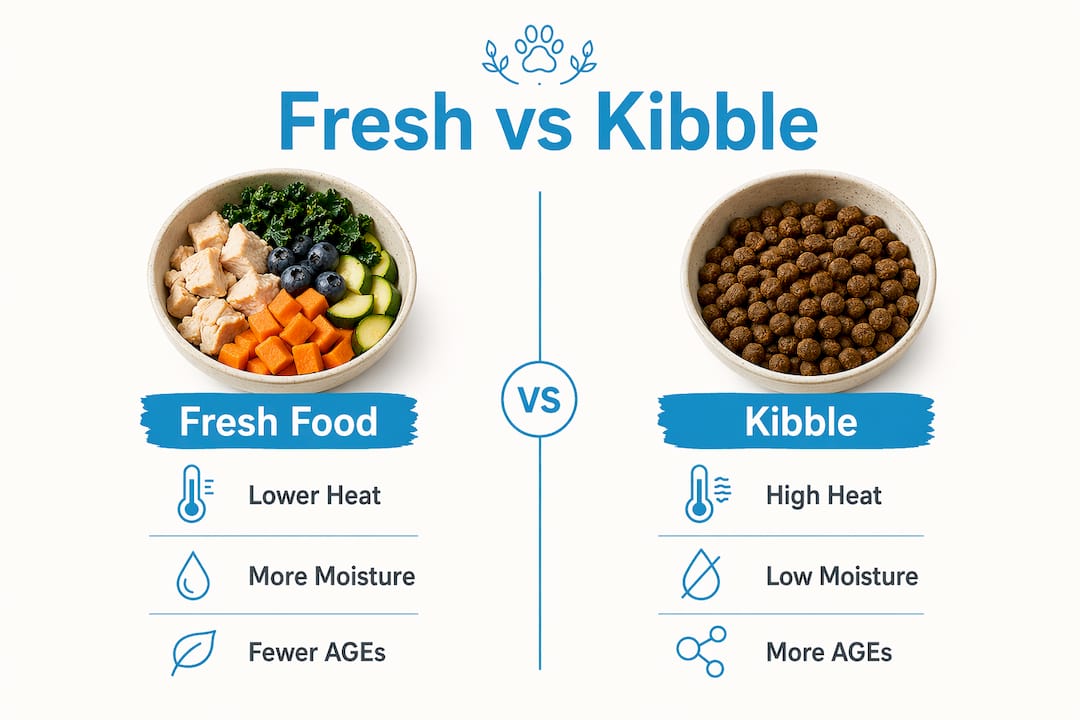
High-heat processing is the single biggest threat to nutrient quality in commercial pet food. Kibble production uses a method called extrusion, which forces ingredients through intense heat and pressure. Canned food relies on retorting, a sterilization process that applies sustained high temperatures. Both methods destroy heat-sensitive vitamins, degrade amino acids like lysine, and trigger chemical reactions that create harmful compounds.
The most concerning of these compounds are advanced glycation end-products, or AGEs. AGEs form when proteins and sugars react under high heat. They accumulate in tissue over time and are linked to inflammation and oxidative stress in both humans and animals. Fresh diets contain up to 120% fewer AGEs than kibble or canned alternatives. That gap is significant because lower AGE exposure means less chronic inflammatory burden on your pet’s body.
Gentle cooking, the method used in most fresh pet food products, uses low temperatures, steaming, or light cooking to kill pathogens while keeping nutrients intact. This approach preserves essential amino acids and fat-soluble vitamins that extrusion destroys. The difference shows up in the final product’s nutritional density.
| Processing type | Heat level | AGE formation | Nutrient retention |
|---|---|---|---|
| Kibble (extrusion) | Very high | High | Low |
| Canned (retorting) | High | Moderate to high | Moderate |
| Fresh (gently cooked) | Low | Low | High |
| Raw | None | Minimal | Highest (with pathogen risk) |
Pro Tip: When reading a pet food label, look for words like “gently cooked” or “lightly steamed” rather than just “natural.” These terms describe the actual process, not just the ingredients.
What does “fresh” actually mean in pet food?
“Fresh” pet food is lightly cooked or steamed to eliminate harmful bacteria while retaining more nutrients than heavily processed alternatives. The term itself is not regulated by AAFCO, the Association of American Feed Control Officials, which sets nutritional standards for commercial pet food in the United States. That gap in regulation matters because any brand can call its product “fresh” without meeting a defined standard.
The phrase “human-grade” carries a similar problem. It signals that ingredients meet standards for human consumption, which is a meaningful quality indicator. But human-grade sourcing alone does not guarantee a nutritionally complete diet for your pet. A meal of chicken breast and sweet potato is human-grade but still lacks the calcium, phosphorus, and trace minerals a dog or cat needs to thrive.
What actually protects your pet is the “complete and balanced” certification backed by AAFCO feeding trials. Look for complete and balanced certifications rather than relying on “fresh” or “human-grade” labels alone. These certifications confirm the diet meets minimum nutritional requirements for your pet’s life stage.
Key things to check on a fresh pet food label:
- “Complete and balanced” statement with an AAFCO nutritional adequacy claim
- Life stage specificity: puppy, adult, or senior formulation
- Named protein sources: chicken, beef, or salmon rather than “meat meal” or “animal by-products”
- Storage instructions: fresh food requires refrigeration or freezing, not a pantry shelf
- Feeding trial notation: “animal feeding tests” confirms real-world validation
Pro Tip: If a fresh pet food product does not list an AAFCO nutritional adequacy statement on the packaging, treat it as a supplement or topper, not a complete diet.
How does moisture content in fresh food benefit pets?
Fresh pet food contains significantly more moisture than kibble, which typically runs at around 10% water content. Higher moisture content supports hydration directly through the diet, reducing the burden on your pet to drink enough water on their own. This matters most for cats, who have a naturally low thirst drive and are prone to chronic kidney disease and urinary tract issues when chronically underhydrated.
Dogs with a history of bladder stones or urinary crystals also benefit from the added moisture in fresh diets. Diluted urine reduces the concentration of minerals that form crystals. Veterinarians who specialize in feline medicine frequently recommend wet or fresh food as a first-line dietary change for cats with recurring urinary problems.
Beyond hydration, moisture supports digestion. Dry kibble absorbs water in the stomach, which can slow gastric emptying and reduce nutrient absorption efficiency. Fresh food, already high in moisture, moves through the digestive tract more smoothly. Pets with sensitive stomachs or inflammatory bowel conditions often show improved stool consistency and reduced gas when switched to fresh or wet diets.
Pets who benefit most from fresh food’s hydration:
- Cats with chronic kidney disease or a history of urinary crystals
- Dogs prone to bladder stones
- Senior pets with reduced kidney function
- Pets who consistently drink less water than recommended
- Animals recovering from illness or surgery who need easy-to-digest nutrition
Are “natural” pet food claims backed by science?
The word “natural” on a pet food label triggers a strong positive response in most pet owners. Between 66% and 84% of consumers prefer products labeled “natural,” a phenomenon researchers call the naturalness bias. The bias operates independently of any actual safety or health evidence. In other words, the label alone shifts perception, regardless of what is inside the bag.
This creates a real problem in the pet food market. Brands use “natural” to signal quality without being required to prove it. A product can contain natural ingredients and still be nutritionally incomplete, poorly stored, or contaminated. Conversely, a product with approved synthetic preservatives can be safer and more nutritionally complete than an all-natural alternative.
“Consumers often confuse ‘natural’ labeling as a guarantee of safety or health benefits. Caution against relying solely on this marketing term.” — Psyche, on naturalness bias
A systematic review published in PubMed found no evidence of harm from approved additives and preservatives used within AAFCO regulatory guidelines. That finding does not mean additives are preferable to fresh ingredients. It means the fear of approved preservatives is not supported by current evidence. The same review found no proof that fresh diets extend longevity compared to quality commercial diets. Fresh food offers real benefits, but those benefits are specific: lower AGE exposure, higher moisture, and better nutrient retention. They are not a guaranteed path to a longer life.
Practical ways to cut through marketing noise:
- Ignore “natural,” “wholesome,” and “premium” without supporting certifications
- Check the AAFCO statement, not the front-of-bag claims
- Read the ingredient list for named proteins and whole food sources
- Review natural ingredient claims against actual nutritional data when possible
- Ask your veterinarian to evaluate any new diet before switching
Key Takeaways
Fresh pet ingredients reduce harmful compounds, support hydration, and preserve more nutrients than heavily processed alternatives, but complete and balanced certification matters more than any single label claim.
| Point | Details |
|---|---|
| AGE reduction is real | Fresh diets contain up to 120% fewer harmful AGEs than kibble, lowering inflammation risk. |
| “Fresh” is not regulated | AAFCO does not define “fresh”; always verify the complete and balanced nutritional claim instead. |
| Moisture drives hydration | Fresh food’s high water content directly supports kidney and bladder health, especially in cats. |
| Naturalness bias misleads | 66–84% of consumers favor “natural” labels regardless of safety evidence; read past the marketing. |
| Toppers are a practical start | Adding fresh food over quality kibble delivers hydration and nutrient benefits without full diet overhaul. |
My honest take on fresh food after years of watching pet owners choose
Most pet owners I talk to come to fresh food for the wrong reason. They are scared of preservatives or convinced that “natural” means safe. The science does not support either fear as a primary driver. What the science does support is the mechanical advantage of gentle cooking: fewer AGEs, more intact amino acids, and meaningfully higher moisture. Those are concrete, measurable differences.
What I find pet owners consistently miss is the transition strategy. Switching a dog or cat abruptly to a fresh diet often causes digestive upset, which gets blamed on the food rather than the speed of change. A gradual introduction over 7–10 days, or starting with fresh food as a topper over existing kibble, avoids that problem entirely. It also makes the cost more manageable.
Storage is the other overlooked factor. Fresh pet food spoils faster than kibble. Portion it correctly, keep it refrigerated or frozen, and never leave it out for more than two hours. I have seen well-intentioned owners undermine a quality fresh diet simply by leaving food in the bowl too long.
My practical advice: consult your vet before any major diet change, especially for pets with existing health conditions. Use fresh food strategically, whether as a full diet or a targeted topper, and always verify that complete and balanced certification before committing to a product. The goal is not purity for its own sake. The goal is a healthier pet.
— Blayne
Fresh ingredient options at Wildrootspet
Pet owners who want to act on the science behind fresh ingredients need products that actually deliver on the promise.

Wildrootspet carries the Raw PMR Pork Meal Blend for Cats and Dogs from Raw Instincts, a prey model raw formula built around whole food sourcing with no fillers or artificial additives. For pet owners not ready for a full raw diet, the blend works as a high-value topper over kibble, adding moisture and nutrient density without a complete diet overhaul. Wildrootspet also carries a range of natural treats and wet food options for cats and dogs, all selected with ingredient quality as the primary filter. Browse the full catalog at wildrootspet.com to find the right fit for your pet’s needs and your budget.
FAQ
What makes pet food “fresh” compared to kibble?
Fresh pet food is gently cooked or steamed at low temperatures to kill pathogens while preserving nutrients. Kibble uses high-heat extrusion that degrades vitamins and creates harmful AGEs.
Is fresh pet food always better than commercial kibble?
Fresh food offers specific advantages: lower AGE content, higher moisture, and better nutrient retention. A systematic review found no evidence that fresh diets extend longevity over quality commercial diets when both are complete and balanced.
How do I know if a fresh pet food is nutritionally complete?
Look for an AAFCO “complete and balanced” statement on the label. “Human-grade” or “fresh” labels alone do not confirm nutritional adequacy for your pet’s life stage.
Can I mix fresh food with my pet’s regular kibble?
Yes. Using fresh food as a topper over quality kibble adds hydration and nutritional variety while keeping cost and storage manageable. Introduce it gradually over 7–10 days to avoid digestive upset.
Are preservatives in pet food dangerous?
Approved preservatives used within AAFCO guidelines show no evidence of harm in current research. The concern about additives is driven more by naturalness bias than by documented safety risks.
Recommended
- Natural ingredients for pet diets: healthier choices – Wild Roots Pet Co.
- Why Premium Pet Food Matters for Your Pet’s Health – Wild Roots Pet Co.
- Why Organic Pet Food? Health, Facts, and What Matters Most – Wild Roots Pet Co.
- Natural Pet Nutrition Tips for a Healthier, Happier Pet – Wild Roots Pet Co.