

Premium pet food is defined as nutritionally complete, high-quality diet formulated with superior ingredients, rigorous testing standards, and targeted nutrient profiles that support long-term pet health. The difference between premium and regular pet food goes far beyond price. It comes down to ingredient sourcing, digestibility, and whether the formula is substantiated by feeding trials or formulation analysis. With 41% of dog owners and 38% of cat owners choosing premium diets in 2024, the shift toward quality nutrition is no longer a niche trend. It reflects a fundamental change in how pet owners think about their animals’ wellbeing.
Why premium pet food matters: what separates it from regular options
The term “premium pet food” is widely used in marketing, but the industry recognizes a more specific standard. Nutritionists and organizations like AAFCO (Association of American Feed Control Officials) and WSAVA (World Small Animal Veterinary Association) define quality by ingredient integrity, nutritional adequacy, and manufacturing controls, not by packaging claims alone.
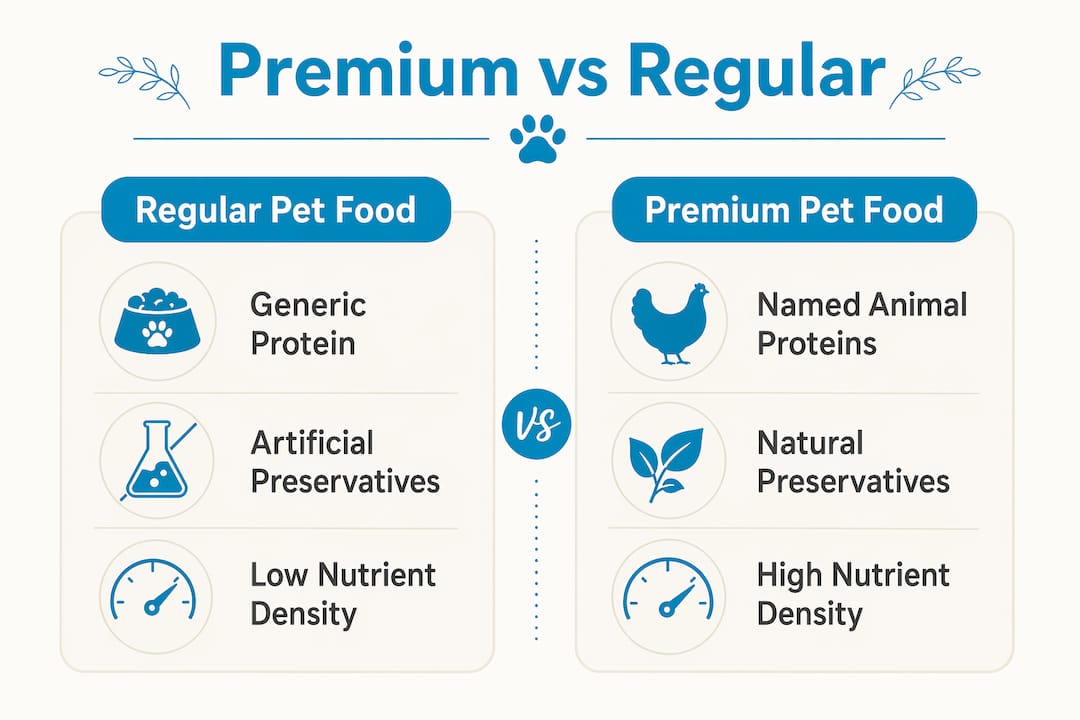
Regular pet food typically relies on lower-cost protein meals, artificial preservatives, and fillers like corn syrup or by-product concentrates. Premium formulas prioritize named animal proteins (chicken, salmon, beef), whole food ingredients, and fats sourced for bioavailability. The distinction matters because ingredient quality directly affects how much nutrition your pet actually absorbs from each meal.
| Feature | Regular pet food | Premium pet food |
|---|---|---|
| Protein sources | Generic meal, by-products | Named animal proteins, whole meats |
| Preservatives | Artificial (BHA, BHT) | Natural (mixed tocopherols, rosemary) |
| Nutritional backing | Formulation only | Feeding trials or formulation with controls |
| Manufacturing oversight | Minimal third-party testing | Stricter quality controls, batch testing |
| Formats available | Primarily dry kibble | Kibble, fresh, freeze-dried, raw blends |
Premium formats like freeze-dried and fresh food rely on strict cold-chain controls to preserve nutrient integrity and reduce pathogens, which is a meaningful contrast to high-heat processed kibble where bioavailability varies by ingredient and processing intensity.
Pro Tip: Look for foods that list a specific animal protein (like “deboned chicken” or “wild-caught salmon”) as the first ingredient. Generic terms like “meat meal” or “animal digest” signal lower ingredient transparency.
How does premium pet food impact health and wellness?
The health benefits of high-quality pet food are measurable and well-documented across several physiological systems. Better ingredients translate directly into better outcomes, and the effects compound over time.
Here is what the research and clinical observation consistently show:
- Digestibility: Premium formulas with named protein sources and whole food ingredients are more digestible, meaning your pet extracts more usable nutrition per cup or serving. Lower-quality foods often pass through with less absorption, which is why pets on premium diets frequently produce smaller, firmer stools.
- Skin and coat health: Omega-3 and omega-6 fatty acids from quality sources like salmon oil and flaxseed directly support skin barrier function and coat luster. Pets with dull coats or chronic itching often show visible improvement within weeks of switching to a higher-quality diet.
- Immune function: Antioxidants from whole food ingredients (blueberries, sweet potato, spinach) and functional additives like prebiotics and probiotics support gut-associated immune tissue, which accounts for a significant portion of a pet’s immune response.
- Energy and vitality: Pets on nutritionally dense diets maintain healthier body weight and muscle mass. Caloric efficiency means they need less food volume to meet energy needs, which reduces digestive burden.
- Longevity and disease prevention: Targeted formulations for life stages (puppy, adult, senior) address changing nutrient requirements. Senior formulas with joint-supporting ingredients like glucosamine and chondroitin address age-related decline proactively.
Meal enhancers and toppers have grown over 120% since 2018, with 16 to 19% of dog and cat owners now using them regularly. This reflects a broader shift toward functional nutrition, where owners are not just feeding for calories but targeting specific health outcomes.
The wellness-focused ingredient trend mirrors what happened in human nutrition a decade ago. Pet owners now read labels, research ingredients, and expect their pet’s food to do more than meet minimum requirements.
What does the science actually say about premium pet food claims?
The science behind premium pet food is more nuanced than most marketing suggests, and that nuance is worth understanding before you spend more on a bag.
A systematic review published in PMC examined the most common quality claims associated with fresh and premium pet food. The findings are instructive. Approved additives and preservatives used within regulatory limits show no evidence of harm to pets, which means the fear-based marketing around “artificial preservatives” is largely unsupported by current evidence. That does not make natural preservatives a bad choice, but it does mean the decision should be based on preference and transparency rather than documented risk.
The human-grade ingredient question is more complicated. Comparative studies on human-grade versus feed-grade ingredients show a high risk of bias, preventing definitive conclusions. Human-grade ingredients may offer benefits, but the current evidence base cannot confirm superiority with confidence. For a deeper look at what human-grade actually means legally and nutritionally, the Wildrootspet guide on human-grade pet foods breaks it down clearly.
Processing method matters, but not in the way most people assume. Thermal and mechanical processing affect nutrient digestibility variably depending on the specific ingredient and method, not simply on processing intensity. Lightly processed does not automatically mean more nutritious.
| Claim | Evidence status | What it means for you |
|---|---|---|
| No artificial preservatives | Approved additives are safe; natural is a preference choice | Choose based on transparency, not fear |
| Human-grade ingredients | Limited evidence; high study bias | Promising but not yet conclusively superior |
| Minimal processing | Effect varies by ingredient and method | Evaluate format alongside ingredient quality |
| Feeding trial tested | Stronger evidence than formulation alone | Prioritize feeding trial claims on labels |
WSAVA guidelines recommend evaluating pet food based on feeding trial evidence, quality controls, and veterinary nutrition input rather than brand marketing alone. This is the most reliable framework available for cutting through the noise.
How to choose the right premium pet food for your pet
Choosing the right food requires more than picking the most expensive bag on the shelf. Follow this process to make a decision grounded in evidence rather than marketing.
- Check the AAFCO statement. Every pet food label should carry an AAFCO “complete and balanced” statement. The AAFCO statement confirms nutritional adequacy but does not assess ingredient quality or long-term health outcomes. It is a floor, not a ceiling.
- Prioritize feeding trial credentials. Foods substantiated by feeding trials offer stronger evidence than those formulated to meet nutrient profiles on paper alone. Feeding trials monitor weight, blood chemistries, and nutrient status over weeks, providing real-world validation.
- Match the formula to your pet’s life stage. Puppies and kittens need higher protein and fat ratios. Senior pets benefit from joint support and adjusted caloric density. A food labeled “all life stages” is formulated to the most demanding stage, which may not be optimal for every animal.
- Evaluate ingredient transparency. Named protein sources, whole food carbohydrates, and clearly identified fat sources are signs of a manufacturer willing to stand behind their formula. Vague ingredient names are a red flag.
- Consider your pet’s health status. Pets with allergies, kidney disease, or digestive sensitivities need formulas tailored to those conditions. For pets with protein sensitivities, a daily wellness formula designed around specific allergen exclusions is worth exploring.
- Consult a veterinary nutritionist for complex cases. Veterinary nutritionists recommend integrating owner lifestyle, pet health status, and label transparency when selecting premium diets rather than relying on branding alone.
Pro Tip: The WSAVA provides a free set of questions you can ask any pet food manufacturer directly. Companies with strong quality controls will answer them confidently. Those that deflect or give vague answers are telling you something important.
Premium vs regular pet food: cost, value, and long-term health
The cost argument against premium pet food usually focuses on the per-bag price. The value argument looks at the full picture.
- Premium pet food is more nutrient-dense, meaning you typically feed smaller portions to meet your pet’s daily requirements. The cost-per-serving gap between premium and regular is narrower than the sticker price suggests.
- Pets on high-quality diets tend to have fewer chronic health issues related to poor nutrition, including skin conditions, digestive disorders, and obesity-related complications. Fewer vet visits offset a meaningful portion of the food cost over a pet’s lifetime.
- The super-premium dog food segment is growing at 7 to 10% annually, driven by younger pet owners who treat their animals as family members and prioritize nutrition accordingly.
- Pet food premiumization is driven by owner perception of health benefits, not price alone. Owners are not paying more for prestige. They are paying more because they see results.
- Budget is a real constraint for many households. A practical middle ground is using a quality base food and adding natural ingredient toppers to improve nutritional density without committing to a full premium formula cost.
The long-term math favors quality nutrition. A pet that maintains healthy weight, strong immunity, and good coat condition through diet requires less intervention over its lifetime.
Key takeaways
Premium pet food delivers measurable health benefits through superior ingredients, rigorous testing, and targeted formulations that regular pet food cannot match at the nutritional level.
| Point | Details |
|---|---|
| Ingredient quality drives outcomes | Named proteins and whole food ingredients improve digestibility and nutrient absorption directly. |
| AAFCO is the floor, not the ceiling | A “complete and balanced” label confirms adequacy but says nothing about ingredient quality or longevity. |
| Science supports selectivity | Approved additives are safe, but feeding trial credentials and WSAVA evaluation criteria are the strongest quality signals. |
| Cost per serving narrows the gap | Nutrient density means smaller portions, making premium food more affordable per meal than the bag price implies. |
| Life stage matching matters | Formulas tailored to puppy, adult, or senior needs address specific nutrient requirements that generic diets miss. |
What I’ve learned watching owners switch to premium nutrition
I have watched a lot of pet owners make the switch to premium food, and the pattern is consistent. The first thing they notice is not a dramatic health transformation. It is smaller stools, a shinier coat, and a dog or cat that seems more satisfied after meals. Those are not marketing claims. They are the predictable results of better digestibility and nutrient density.
What surprises me is how many owners still conflate “premium” with “expensive brand” rather than with verifiable quality markers. A food can carry a premium price and still use vague ingredient sourcing. Conversely, some mid-tier brands meet WSAVA evaluation criteria and use feeding trial substantiation. The label does the work if you know how to read it.
The misconception I push back on hardest is the idea that raw or minimally processed food is automatically superior. Processing method affects nutrient availability in ways that depend on the specific ingredient. A lightly processed food with poor protein sources is not better than a well-formulated kibble with named meats and feeding trial backing. Context matters more than format.
My practical advice: start with the premium pet nutrition guide to build your evaluation framework, then apply WSAVA criteria to any brand you are considering. Budget constraints are real, but even partial upgrades, like adding a quality topper to a solid base food, move the needle on health outcomes. You do not have to do everything at once to do something meaningful.
— Blayne
Explore premium nutrition options at Wildrootspet
Wildrootspet carries a curated range of products built around the principles covered in this article: named protein sources, transparent ingredients, and formulas designed for real health outcomes.

The Raw PMR Pork Meal Blend is a prey model raw formula for both cats and dogs, built on whole-food nutrition without fillers or artificial additives. For owners who want to upgrade an existing diet without a full switch, the fish meal topper adds low-fat, high-protein nutrition to any base food. Every product on the Wildrootspet platform is selected with ingredient transparency and pet wellness as the primary criteria, not shelf appeal.
FAQ
What makes pet food qualify as premium?
Premium pet food uses named animal protein sources, whole food ingredients, and natural preservatives, and is substantiated by feeding trials or rigorous formulation analysis. WSAVA and AAFCO criteria provide the most reliable evaluation framework beyond brand marketing.
Is premium pet food worth the extra cost?
Premium pet food is more nutrient-dense than regular options, meaning smaller portions meet daily requirements, which narrows the actual cost-per-serving gap. Reduced veterinary costs from fewer diet-related health issues add further long-term value.
How do I know if a pet food has been feeding trial tested?
The AAFCO statement on the label will specify whether the food was substantiated by feeding trials or formulated to meet nutrient profiles. Feeding trial language reads as “animal feeding tests using AAFCO procedures” and represents stronger real-world evidence.
Are artificial preservatives in regular pet food harmful to pets?
Systematic reviews show that approved additives and preservatives used within regulatory limits produce no evidence of harm in pets. The preference for natural preservatives is valid but should be based on transparency preferences rather than documented health risk.
Can I improve my pet’s diet without switching to a full premium formula?
Yes. Using functional meal toppers with quality protein sources or natural ingredient enhancers can meaningfully improve the nutritional density of a base diet. APPA data shows topper use has grown over 120% since 2018, reflecting how owners are upgrading nutrition incrementally.