

More pet owners are asking why non-GMO pet food deserves a place in their dog or cat’s bowl, and that question deserves a real answer. Not a marketing pamphlet. The rise of ingredient transparency in human food has naturally pushed into pet nutrition, but a lot of the conversation mixes genuine science with wishful thinking. This article breaks down what non-GMO actually means on a pet food label, what the research does and does not support, and how to make a genuinely informed decision for your specific animal.
Table of Contents
- Key takeaways
- Why non-GMO pet food: what the label actually means
- Health and nutritional benefits worth knowing
- What the science actually supports
- How to choose non-GMO pet food wisely
- Non-GMO vs. organic vs. conventional pet food
- My take on non-GMO pet food after years of watching this space
- Feed your pet the ingredients they deserve
- FAQ
Key takeaways
| Point | Details |
|---|---|
| Non-GMO is a sourcing standard | The label reflects ingredient origin and verification, not a guaranteed health outcome for your pet. |
| Third-party verification matters | The Non-GMO Project uses testing, audits, and a 0.9% action threshold to back up its seal. |
| Pesticide exposure is a real concern | Non-GMO ingredients typically carry lower herbicide residues, reducing toxic burden on pet organs. |
| Formulation still drives nutrition | A well-balanced conventional diet often outperforms a poorly formulated non-GMO one. |
| Partial adoption is a valid strategy | Even incorporating 50% non-GMO feeding can meaningfully reduce chemical exposure over time. |
Why non-GMO pet food: what the label actually means
Before deciding whether non-GMO pet food is right for your animal, you need to understand what the label is actually claiming. Genetic modification involves inserting or altering DNA in a crop or organism to produce a desired trait, such as resistance to herbicides or improved yield. Traditional breeding, by contrast, works within a species using natural selection or crossbreeding over generations. That distinction matters because it affects the protein structures your pet’s body encounters at the cellular level.
The most recognized standard in North America is the Non-GMO Project Verified seal. Verification is not just a label claim. It requires risk-based ingredient testing, traceability documentation, and annual onsite audits. The action threshold sits at 0.9% GMO contamination, which is a practical acknowledgment that total zero contamination is nearly impossible in modern agricultural supply chains. That threshold makes the standard rigorous without being dishonest about the realities of farming.
Pro Tip: When you see “made with non-GMO ingredients” without a verified seal, treat it as an unconfirmed marketing claim. Third-party verification reduces misleading claims by requiring actual testing, not just company self-reporting.
Here is a quick comparison to help you cut through the label confusion:
| Label | GMO-free status | Pesticide restrictions | Third-party audit | Notes |
|---|---|---|---|---|
| Non-GMO Project Verified | Yes (to 0.9% threshold) | No requirement | Yes, annual | Ingredient-focused standard |
| USDA Organic | Yes (required) | Yes, strict | Yes | Covers farming and processing |
| Non-verified “non-GMO” claim | Unconfirmed | No requirement | No | Marketing claim only |
Health and nutritional benefits worth knowing
The most compelling reasons pet owners choose non-GMO ingredients fall into three categories: pesticide exposure, immune response, and nutrient quality. Each has a different level of scientific backing, and understanding that difference helps you set realistic expectations.
Non-GMO ingredients typically carry lower herbicide residues, particularly glyphosate, which is widely used on GMO crops engineered for herbicide tolerance. Glyphosate residues have been linked to disruption of beneficial gut bacteria in several animal studies, and non-GMO diets support healthier digestion by reducing that microbial interference. For pets with sensitive stomachs or recurring digestive issues, that distinction can matter.

On the immune side, the argument is more nuanced. Genetically modified proteins may introduce molecular structures that a pet’s immune system does not readily recognize, which could contribute to inflammatory immune responses. Veterinary practitioners have reported allergy relief in pets after transitioning to non-GMO diets, though peer-reviewed clinical trials specific to pet populations are still limited. Think of it as emerging evidence rather than settled science.
The nutritional angle is perhaps the strongest. Research suggests that organic and non-GMO crops can contain up to 69% more antioxidants than conventionally grown alternatives. Antioxidants support cellular repair and immune function, both of which matter for longevity in companion animals.
- Reduced pesticide load: Non-GMO sourcing limits exposure to residual herbicides like glyphosate that accumulate in liver and kidney tissue over time.
- Gut microbiome support: Avoiding glyphosate-heavy ingredients may preserve the beneficial bacterial balance your pet’s digestive system depends on.
- Stronger antioxidant profile: Non-GMO and organic crops often show measurably higher levels of antioxidants and key vitamins.
- Natural protein recognition: Unmodified protein structures are generally more familiar to your pet’s immune system, potentially reducing allergic load.
Pro Tip: If your pet has ongoing skin issues, recurring ear infections, or loose stools, natural ingredient sourcing is worth exploring as one variable to adjust, not the only one.
What the science actually supports
Here is where you need the full picture. The research on non-GMO pet food specifically is still catching up to the marketing. A systematic review of quality claims in fresh pet food found that direct clinical trials linking non-GMO pet diets to reduced allergies or disease outcomes are largely absent. What exists is broader nutritional data, digestibility studies, and extrapolations from human nutrition research.
“Non-GMO labeling should be treated primarily as an ingredient sourcing and values choice rather than a proven pet health intervention, until pet-specific clinical trials establish direct outcome links.” Systematic Review and Meta-Analysis of Quality Claims Associated with Fresh Pet Food
That context does not dismiss the benefits. It calibrates them. Ingredient processing effects, for instance, outweigh genetic origin in determining nutritional outcomes in many cases. A heavily processed non-GMO kibble may deliver less nutritional value than a minimally processed conventional raw food. Meanwhile, digestibility studies on plant-based pet diets show that nutrient absorption above 80% is achievable with proper formulation, regardless of GMO status. The lesson is that formulation quality and sourcing work together.
| Research area | Current evidence strength | Key gap |
|---|---|---|
| Non-GMO and allergy reduction in pets | Weak, anecdotal reports only | No randomized controlled pet trials |
| Pesticide residue reduction | Moderate, based on crop data | Limited pet-specific bioaccumulation studies |
| Antioxidant levels in non-GMO crops | Moderate, human crop studies | Translation to pet health outcomes unconfirmed |
| Ingredient processing vs. GMO status | Strong, meta-analysis data | Often overlooked in marketing claims |
How to choose non-GMO pet food wisely
Knowing what the label means is step one. Knowing how to shop for it is step two. These criteria will save you from buying something that sounds good but does not actually deliver.
- Look for the Non-GMO Project Verified seal. This is the clearest signal that the claim has been tested and audited, not just printed on a bag.
- Check the ingredient list for high-risk GMO crops. Corn, soy, canola, and sugar beet are the most commonly genetically modified ingredients in commercial pet food. If any of these appear without a verified seal, the non-GMO status is uncertain.
- Confirm the food is nutritionally complete. Non-GMO status means nothing if the food lacks proper calcium-to-phosphorus ratios, adequate taurine, or life-stage-appropriate protein levels. Look for an AAFCO statement on the label.
- Match the diet to your pet’s life stage. A non-GMO formula designed for adult dogs will not meet a puppy’s caloric or developmental needs. Life stage suitability matters more than label claims.
- Consider a partial transition if cost is a barrier. Even 50% non-GMO feeding reduces chemical exposure compared to a fully conventional diet. Start with meals, then layer in non-GMO treats and toppers.
Pro Tip: Transitioning slowly over 7 to 10 days by mixing the new food with your pet’s current food reduces digestive upset, regardless of whether you are switching to a premium pet nutrition option or a different protein source.
You can also explore grain-inclusive pet food options that use non-GMO verified grains, which offer digestible carbohydrates without the risks tied to heavily modified corn or soy varieties.
Non-GMO vs. organic vs. conventional pet food
These three categories overlap in some places and diverge sharply in others. Understanding how they relate helps you decide where to spend your budget.
Organic certification in the U.S. actually requires non-GMO ingredients by default, making every USDA Organic pet food also non-GMO. But the reverse is not true. A non-GMO verified product can still use synthetic fertilizers and pesticides during farming, as long as the crop itself was not genetically modified. For pet owners who want both standards, the intersection of organic and non-GMO verified is the most stringent option. Read more about that comparison in the organic pet food guide.
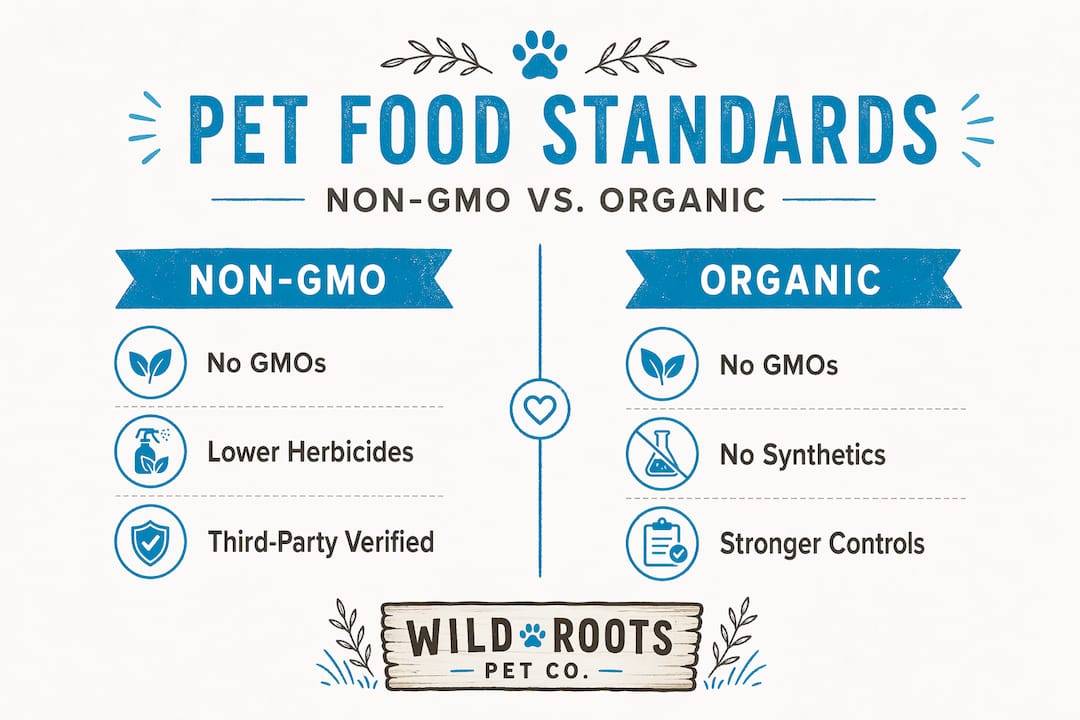
Cost is a real factor. Organic pet food typically runs 20 to 40 percent higher than conventional options, and non-GMO verified products sit somewhere in between. Availability can also be a limitation depending on your location, though online retailers have significantly expanded access.
Non-GMO Verified pros and cons:
- Pro: Rigorous third-party testing and annual audits
- Pro: Reduces high-risk GMO ingredient exposure
- Con: Does not restrict pesticide or synthetic fertilizer use
- Con: Certification does not guarantee overall nutritional quality
Organic pros and cons:
- Pro: Covers both GMO exclusion and pesticide restrictions
- Pro: Regulated by USDA with strong oversight
- Con: Higher price point limits accessibility for many pet owners
- Con: Does not always mean minimally processed
Conventional pros and cons:
- Pro: Most affordable and widely available
- Pro: Many conventional brands meet AAFCO nutritional standards
- Con: May include GMO ingredients with herbicide residues
- Con: Less ingredient transparency and fewer third-party audits
My take on non-GMO pet food after years of watching this space
I have watched the non-GMO conversation evolve from a fringe concern to a mainstream buying criterion, and I have seen a lot of pet owners make the same mistake along the way. They swap to a non-GMO labeled food, expect a transformation, and then feel confused when nothing dramatic changes. What I have learned is that the label is a starting point, not a finish line.
In my experience, the pets that benefit most from a dietary shift are the ones whose owners change multiple variables at once: cleaner sourcing, better protein quality, reduced processing, and more transparency about additives. Non-GMO status as a single attribute does not move the needle as reliably as pairing it with genuinely high-quality formulation.
What I find most useful is treating non-GMO as a values alignment signal. It tells you the brand prioritizes ingredient integrity enough to get audited. That kind of accountability tends to correlate with better overall quality standards throughout the supply chain. Still, I always tell pet owners to loop in their vet when making diet changes. No article replaces a professional who knows your specific animal.
— Blayne
Feed your pet the ingredients they deserve
If you have been researching why non-GMO pet food is worth the investment, Wildrootspet makes it easy to put those values into practice without guesswork.

The Raw PMR Pork Meal Blend is built on natural protein sourcing with minimal processing, the exact kind of formulation that makes a non-GMO approach work rather than just look good on the bag. For a simple entry point, the fish meal topper lets you layer cleaner ingredients onto your pet’s current diet without a full transition. Wildrootspet also carries freeze-dried pork trail snacks that align with the natural ingredient standards covered throughout this article. Every product is selected with the same scrutiny you would apply yourself.
FAQ
What does non-GMO mean in pet food?
Non-GMO pet food uses ingredients that have not been genetically engineered. The most credible products carry the Non-GMO Project Verified seal, which requires testing, traceability, and annual audits rather than a simple self-declaration.
Is non-GMO pet food actually better for pets?
Non-GMO pet food can reduce herbicide residue exposure and support gut health, but direct clinical trials specific to pet health outcomes are still limited. Quality formulation matters as much as GMO status when evaluating overall nutritional benefit.
What is the difference between non-GMO and organic pet food?
USDA Organic certification requires non-GMO ingredients by default and also restricts synthetic pesticides and fertilizers. Non-GMO verified products meet the genetic modification standard but do not necessarily restrict farming chemicals.
Which GMO ingredients should I watch for in pet food?
Corn, soy, canola, and sugar beet are the most commonly genetically modified crops in commercial pet food. If these appear in an ingredient list without a verified non-GMO seal, their modification status is unconfirmed.
Can I mix non-GMO and conventional pet food?
Yes. Even partial non-GMO feeding reduces chemical exposure compared to a fully conventional diet. Adding a non-GMO topper or treat to a conventional base is a practical and budget-friendly starting point.
Recommended
- Why Organic Pet Food? Health, Facts, and What Matters Most – Wild Roots Pet Co.
- Natural ingredients for pet diets: healthier choices – Wild Roots Pet Co.
- What are human-grade pet foods? Your complete guide – Wild Roots Pet Co.
- Grain-inclusive pet food: nutrition, benefits, and how to choose – Wild Roots Pet Co.