

Pet food by-products are defined as the non-muscle-meat parts of slaughtered animals, including organs, bones, and connective tissue, and the reason to avoid by-products in pet food comes down to one word: transparency. Not all by-products are equal. The critical divide is between named-species by-products, such as “chicken by-product meal,” and generic versions labeled simply “animal by-product meal.” Generic labels hide the source species entirely, making it impossible to know what your dog or cat is actually eating. AAFCO regulates pet food ingredient definitions, but it does not require manufacturers to name the species behind a generic by-product label. That gap is where the real risk lives.
What are pet food by-products and how do named vs. generic versions differ?
Pet food by-products include parts of the animal not used in human food production. That covers organs like liver and kidney, as well as lungs, spleen, bone, and connective tissue. What is excluded by AAFCO definition: hair, hooves, horns, hide trimmings, and feathers. So the category is not automatically low quality.
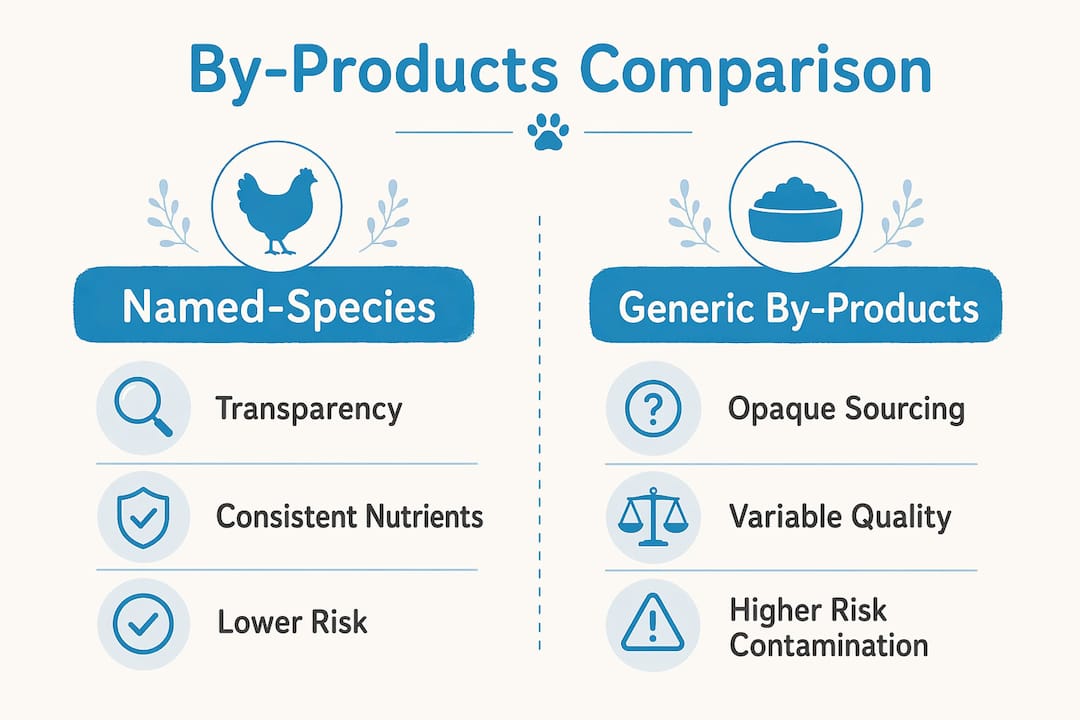
The split that matters is species identification. A named-species by-product, such as “chicken by-product meal” or “turkey by-product meal,” tells you the source animal. That specificity means the nutrient profile is relatively predictable from batch to batch. A generic label like “animal by-product meal” or “meat and bone meal” tells you nothing about the source.
Generic labels conceal species identity, allowing manufacturers to switch raw material suppliers week to week based on cost. The finished product may contain chicken one month and pork the next, with no label change required. That practice creates unpredictable nutrient profiles and makes it nearly impossible to manage your pet’s diet with any precision.
- Named-species by-products: Source animal is declared (e.g., chicken, beef, salmon). Nutrient profile is consistent and traceable.
- Generic by-products: Source animal is undisclosed. Ingredient composition can shift without notice.
- Organ meats in named by-products: Liver, heart, and kidney are nutritionally dense and intentionally included in quality formulas.
- Rendered generic meals: Processed at high heat from mixed, unidentified animal sources. Nutrient density is inconsistent.
Pro Tip: When reading a pet food label, look for the species name before the word “by-product.” If you see only “animal” or “meat,” that is a generic label. Put the bag down.
Why are generic by-products a health risk for pets?
The health risks of by-products in pet food are concentrated in the generic, unnamed category. The rendering process used to create these meals applies high heat to mixed animal material. That process removes moisture efficiently, but it also concentrates contaminants including heavy metals, pharmaceutical residues, and persistent chemicals like PFAS and pentobarbital.
Pentobarbital is a euthanasia drug used in livestock and companion animals. It has been detected in rendered generic by-product meals because the source animals are not always slaughtered under food-safety protocols. FDA recalls in 2018 and 2021 linked generic “animal by-product meal” to contamination with pentobarbital and aflatoxins, both of which pose direct health hazards to dogs and cats. That is not a theoretical risk. Those recalls happened.
“Ingredient sourcing traceability is the best predictor of premium-grade, consistent nutritional pet food.” — KibbleIQ
The risks compound for pets with food sensitivities. Batch-to-batch variation in generic by-products makes elimination diets impossible to execute correctly. An elimination diet requires feeding a single, known protein source to identify allergens. Generic by-products defeat this by mixing multiple unknown species in every batch.
Here is a clear picture of the layered risks:
- Contamination from rendering. High-heat processing concentrates pentobarbital, aflatoxins, PFAS, and heavy metals present in the raw material.
- Supplier switching. Manufacturers use generic labels to swap ingredient sources freely, creating nutritional inconsistency without any label change.
- Allergy management failure. Pets on elimination diets cannot be accurately assessed when their food contains unidentified species.
- Regulatory blind spots. AAFCO definitions permit generic labels, so the burden of scrutiny falls entirely on the pet owner.
The importance of pet food quality is not just about premium pricing. It is about knowing what is in the bag and trusting that it stays consistent.
Is there any nutritional value in by-products?
The honest answer is yes, and the nuance here matters. Organ meats like liver, heart, and kidney supply vitamins A, B-complex, iron, taurine, and CoQ10, all of which are critical for pet health. A named-species by-product that includes these organs is not a filler. It is a legitimate, nutrient-dense ingredient.

The problem is that marketing often demonizes all by-products to justify higher price points on “by-product-free” foods. Veterinarians note that the “filler” stigma attached to by-products is largely a marketing tactic rather than a scientifically grounded health claim. The real issue is not the presence of by-products. The real issue is whether you can identify what species they came from.
| Ingredient type | Species known? | Nutrient consistency | Contamination risk |
|---|---|---|---|
| Named-species organ meat (e.g., chicken liver) | Yes | High | Low |
| Named-species by-product meal (e.g., chicken by-product meal) | Yes | Moderate to high | Low to moderate |
| Generic by-product meal (e.g., animal by-product meal) | No | Low | High |
| Generic meat and bone meal | No | Very low | High |
The nutritional value of pet food depends heavily on ingredient sourcing, not just ingredient category. A food with “chicken by-product meal” from a traceable, single-source supplier can outperform a food with a vague “premium protein blend” from an unnamed source.
Pro Tip: Check whether a brand publishes its sourcing standards or works with a veterinary nutritionist. Brands that do are far more likely to use named-species ingredients consistently. Species-appropriate formulas are built around this principle.
Feeding trials and veterinary nutritionist involvement provide a practical framework for trusting pet food quality beyond what the label alone can tell you. Look for brands that have completed AAFCO feeding trials, not just formulation-based compliance.
How do you choose pet food that avoids problematic by-products?
Choosing better pet food starts with reading the ingredient list correctly. The best ingredients for pet food are those you can trace to a specific animal and a specific part of that animal. Here is what to look for and what to avoid.
What to look for on the label:
- A named species before every protein source: “chicken,” “beef,” “salmon,” “turkey,” not “animal” or “meat.”
- Organ meats listed by name: “beef liver,” “chicken heart,” “pork kidney.”
- A short, readable ingredient list where you recognize most items.
- An AAFCO statement confirming the food meets nutritional standards through feeding trials, not just formulation.
What to avoid:
- “Animal by-product meal,” “meat and bone meal,” or “poultry by-product meal” without a named species.
- Ingredient lists where generic proteins appear in the top five ingredients.
- Brands that do not publish sourcing information or respond vaguely to direct questions about suppliers.
Ingredient opacity is the core problem, not the presence of by-products. A brand that names every ingredient and its source is demonstrating accountability. A brand hiding behind generic labels is prioritizing cost flexibility over your pet’s health.
For pets managing food allergies, the stakes are higher. Named-species ingredient integrity is mandatory for effective elimination diets. Generic by-products mix multiple unknown species in every batch, which makes allergy diagnosis unreliable. If your vet has recommended an elimination diet, look for allergen-specific pet diets built on single, traceable protein sources.
Human-grade pet foods and minimally processed options represent the clearest alternative to generic by-product meals. These formats require ingredient sourcing that meets human food safety standards, which eliminates the contamination pathways that make generic rendered meals risky. The tradeoff is cost, but for pets with chronic sensitivities or health conditions, the investment is justified.
WSAVA and other veterinary nutrition authorities recommend brands that use species-specific proteins and demonstrate ingredient traceability. That guidance is the clearest signal available to pet owners navigating a crowded, often misleading market.
Key Takeaways
Generic by-products in pet food are the real concern, not named-species organ meats, and ingredient transparency is the single most reliable indicator of pet food quality.
| Point | Details |
|---|---|
| Generic labels hide species identity | “Animal by-product meal” allows supplier switching without label changes, creating nutritional inconsistency. |
| Named-species organs are nutritious | Liver, heart, and kidney supply vitamins A, B-complex, taurine, and CoQ10 critical for pet health. |
| Rendering concentrates contaminants | High-heat processing increases concentrations of pentobarbital, PFAS, and aflatoxins in generic meals. |
| Allergy management requires traceability | Elimination diets fail when generic by-products mix unknown species in every batch. |
| Transparency is the quality standard | Brands using named-species ingredients and feeding trials provide the most reliable nutrition. |
The label tells you everything, if you know how to read it
I have spent years looking at pet food labels, and the single most consistent pattern I see is this: the brands that use generic by-product language are almost always the ones that cannot answer a direct question about their sourcing. Ask a brand where their “animal by-product meal” comes from, and watch what happens. You will get a press release, not an answer.
The demonization of all by-products frustrates me because it muddies the real issue. Beef liver is a by-product. Chicken heart is a by-product. These are among the most nutrient-dense ingredients you can put in a pet food. The problem has never been the category. The problem is the word “animal” sitting in front of “by-product” with no species attached.
What I tell every pet owner who asks: treat ingredient opacity the same way you would treat opacity in your own food. If a product cannot tell you what animal it came from, that is not a minor labeling technicality. That is a supply chain designed to hide something, whether that something is cost-cutting, inconsistent sourcing, or worse.
The pet food industry has improved, but it still relies on consumer inattention. The owners who read labels carefully, ask brands hard questions, and choose natural, traceable ingredients are the ones whose pets eat consistently well. That vigilance is not paranoia. It is the minimum standard your pet deserves.
— Blayne
What Wildrootspet offers instead of generic by-products
Wildrootspet carries products built around named-species ingredients with clear sourcing, no generic by-product meals, and no ingredient guesswork.

The Raw PMR Pork Meal Blend is a minimally processed, species-specific option for cats and dogs, including pets managing protein sensitivities. For a simple, traceable protein boost, the fish meal topper delivers named-species nutrition in a low-fat format that works alongside any base diet. Every product at Wildrootspet names the animal, names the part, and skips the filler. If you are moving away from generic by-product formulas, these are the kind of transparent, whole-food options worth adding to your pet’s bowl.
FAQ
What exactly are by-products in pet food?
By-products are the non-muscle-meat parts of slaughtered animals, including organs, bones, and connective tissue. AAFCO definitions exclude hair, hooves, horns, and feathers from the category.
Are all pet food by-products bad for dogs and cats?
No. Named-species organ meats like chicken liver and beef heart are nutritionally dense and beneficial. The concern applies specifically to generic, unnamed by-product meals where the source species is unknown.
Why are generic by-product meals linked to recalls?
FDA recalls in 2018 and 2021 connected generic “animal by-product meal” to contamination with pentobarbital and aflatoxins. The rendering process used to create these meals can concentrate pharmaceutical residues and toxins from unvetted source animals.
Can I feed a pet with allergies a food containing by-products?
Only if the by-products are named-species and fully traceable. Generic by-products mix unknown species in every batch, which makes elimination diets unreliable and allergy diagnosis inaccurate.
How do I know if a pet food brand uses quality ingredients?
Look for named species before every protein source, AAFCO feeding trial certification, and a brand that publishes sourcing standards or works with a veterinary nutritionist. Brands that answer sourcing questions directly are the ones worth trusting.